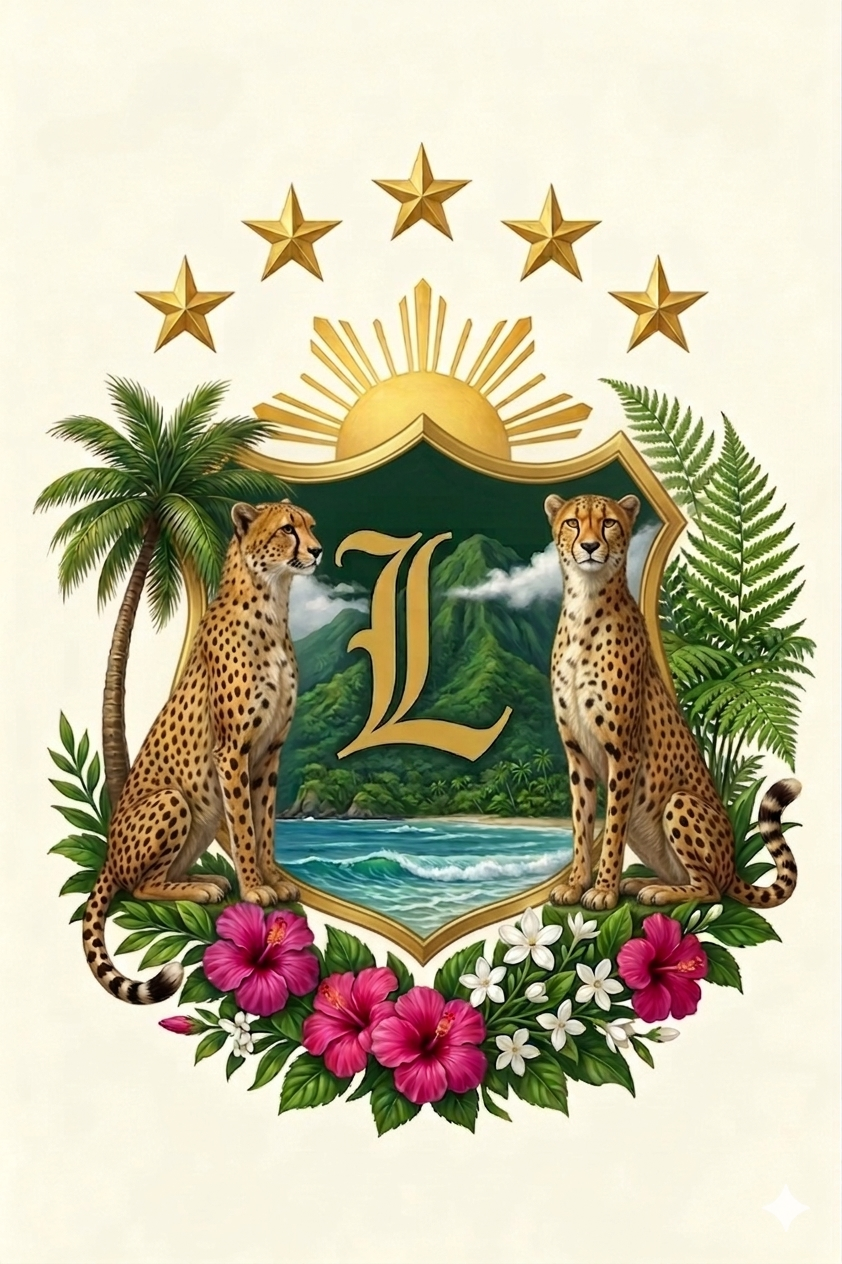
Luoma Family Crest
Brand Book & Identity Standards
Brand Book & Identity Standards
The Luoma Family Crest is more than a logo — it is a living symbol of who we are and where we come from. Designed to stand for generations, it encodes the story of a family woven from four distinct cultures: the Philippines, Jamaica, Finland, and the United States. Every element was chosen with intention, from the cheetahs that guard the shield to the stars that crown it.
At its heart, the crest is about unity. Bryan's Finnish resilience meets Delores's Jamaican warmth; Philippine roots meet American ambition. The five stars — one for each member of the family — arc above a Philippine sun, grounding the design in the place the Luomas now call home. The cheetah, shared with Tahche, carries forward the values that define both the family and the enterprise Bryan built: speed, discipline, and an instinct for excellence.
This Brand Book is the official reference for reproducing, sizing, and placing the crest across all media — from embroidered polos to engraved metal, from printed invitations to digital screens. Treat the crest with the same care you would a family heirloom, because that is exactly what it is.
Two seated cheetahs — speed, discipline, vigilance, and elite focus. They also link to Tahche, Bryan's company, sharing a mascot between family and enterprise.
European heraldic form conveying strength and legacy. The "L" monogram anchors the composition at all sizes.
A rising half-sun with five eight-pointed stars at the top — honoring Delores and the Philippines. The five stars represent Bryan, Delores, Gabe, Sylvia, and Scarlett.
Mountain peaks beneath the monogram representing the Luoma home site — elevation, aspiration, and a geographic anchor in the Philippines chapter.
Wave lines and island silhouettes — the Philippine archipelago, travel between regions, and Bryan's multi-geographic life across USA, Philippines, Jamaica, and Finland.
Philippine and Jamaican warmth. Welcome, hospitality, endurance. Representing cultural roots and family blending.
Bryan's Finnish ancestry — resilience, quiet strength, and northern heritage. Balances the left-right cultural symmetry of the crest.
Hibiscus (Jamaica) and Sampaguita (Philippines) with leafy vines — union of cultures, marriage, and a symbolic foundation beneath the shield.
Green & gold — prestige, heritage, and warmth. For ceremonial and print use.
Green & gold only — simplified for mid-detail reproduction.
True monochrome version for embroidery, engraving, and small-scale use.
Below a certain size, fine details like the stars, fern leaves, and floral base become illegible. These minimums protect the crest's integrity across different reproduction methods.
Embroidery is the most demanding medium for the crest. Thread count, fabric weave, and stitch density all affect legibility. These sizes assume standard-density embroidery (approximately 40,000 stitches per square inch) on woven cotton or piqué polo fabric.
Where the crest is placed determines which variant and size to use. As a general rule: the smaller and more constrained the location, the simpler the variant should be.
| Location | Recommended Size | Recommended Variant | Notes |
|---|---|---|---|
| Left Chest | 2.5 – 3.25 in | Single or Two Color | The most common placement. At 3.0 in+, Two Color gives the gold accent without overwhelming the garment. Below 3.0 in, use Single Color for clean legibility. |
| Sleeve | 2.0 – 2.5 in | Single Color | Sleeves curve around the arm, which compresses the crest visually. Single Color reads best here. Position centered on the outer bicep, 1.5 in below the shoulder seam. |
| Hat Front | 2.25 – 2.75 in | Single or Two Color | Hats have a rigid panel that supports embroidery well. Two Color works nicely on dark-colored hats (forest green, navy). Single Color on lighter hats (ivory, khaki). |
| Jacket Back | 5 – 7 in | Full Color or Two Color | The showcase placement. Full Color is the most dramatic. Center the crest horizontally and position the top edge 2–3 in below the collar seam. |
| Collar / Cuff | 0.75 – 1.0 in | Single Color only | Very small — only the Single Color silhouette survives at this size. Works as a subtle "signature" detail on dress shirts and outerwear cuffs. |
| Tote / Bag | 3.0 – 5.0 in | Any variant | Flat canvas totes and leather bags give the crest a firm surface. Choose the variant based on the bag color — Full Color on ivory/tan, Two Color on dark leather. |
The three crest variants exist for a reason — each is optimized for different reproduction methods, sizes, and surfaces. Choosing the wrong variant for the medium will result in either lost detail or unnecessary complexity. Use this guide when deciding which to specify.
| Scenario | Variant | Why |
|---|---|---|
| Wedding invitations, framed prints, website hero images | Full Color | High-resolution media where every detail — cheetah spots, hibiscus petals, mountain texture — is visible and impactful. |
| Polo shirts (left chest, 3 in+), branded tote bags, screen-printed apparel | Two Color | Enough detail to recognize the shield elements, but simplified to two thread/ink colors. Keeps embroidery costs reasonable while adding the gold accent that defines the brand. |
| Hat embroidery, sleeve patches, pen engravings, collar details, business cards | Single Color | At small sizes or on textured surfaces, color separation fails. A single-tone silhouette guarantees the crest reads cleanly from any distance. |
| Laser-etched metal, leather debossing, wax seals | Single Color | These media physically cannot reproduce color. The single-color outline was designed specifically for monochrome substrates. |
| Foil-stamped stationery, two-pass screen printing | Two Color | Two foil passes (green + gold) or two ink passes create a premium result without the complexity of full-color reproduction. |
| Digital screens, social media avatars, email signatures | Full Color (large) or Single Color (small) | If the crest will display at 100px+ on screen, use Full Color. For favicons, app icons, or small UI elements, use the Single Color silhouette. |